Showing posts with label Anglesey. Show all posts

Monday, 4 April 2011

A Wakeful Green

Forests have seasons all of their own. Today, wandering through the forest I listened to the call of the sparrowhawk, I heard the wind rustling through the trees and watched the tall slender saplings bending and swaying to a rythmic dance.

My two favourite seasons are Spring and Autumn and today I felt I was walking with each side by side. Gold and rust coloured leaves littered the floor and my eyes rested upon the russet hues of last years bracken while all the while leaves are unfurling, the brambles are tentatively marking out their territory and ferns are still enchanting with their fossil like curls. So much is happening.

I miss this forest feel. I spent so much time gazing at the dreamcatcher/medicine wheel like patterns to the log rings whilst my friend could not help noticing the runic symbols scattering the forest floor. Newborough Forest lies at the other side of the Island to me and I get the impression that large forests are not natural to the isle of Anglesey. Anglesey is essentially a small island known for its farming history and 200 miles of magnificent coastline. I am blessed with miles of hedgerows, gorse and heather lined fields and coastal paths, wildflowers and alpines unique to Anglesey with unusual healing properties.

Having so much outdoor beauty to focus on I find that I have not been creating art or pieces of felt but instead have been occupied with creating willow domes, tending to my garden, going on long walks and getting inspired by foraging. I have been adding gorse flowers o my salads and have made the gorse flower cordial, which is delicious, and dyed wool in gorse. I have plans to flower pound gorse flowers through a stencil. I quite like the idea of making a CND stencil to pound through, and later in the year if i am feeling more adventurous I think making stencils of peace symbols with a rainbow of different pounded flowers.

Next, I think I will be making a study of heather. I am going to help my aunt and uncle create a heather thatch roof for their pagoda, I think I'll make a heather besom, some heather tea for my mam to use as offerings at her Buddhist Centre, some heather wine and of course use heather as a natural dye.

I'll keep you posted with lots of pictures. Until then enjoy your spring and thanks for sticking with me during my silent unproductive months xJ

Tuesday, 16 November 2010

Sharing Treasure #3 Burial Chambers and Iron Age Hill Forts

Bryn Celli Ddu Burial Chamber


Bryn Celli Ddu is one of the most spectacular burial chambers that I have come across. Most, if not all, burial chambers would have been mounded over like this one. The burial chambers that you see showing the exposed stones and top caps like in Bodwyr below have been excavated and would have been hill like originally.


Bryn Celli Dddu is one of the most exciting and pleasing burial chambers that I have ever visited. Not just because the mound like hill covers it, or because you can walk (standing) right into it or that you can see straight through one side to the other, or because my friend found a love letter to a departed soul saying how much they were missed and how sorry they could not be all that was needed during the period of illness before departing or that because when you lie with your feet at the top of the mound and your head above the door plinth you feel like you are going to slide down the hill so quickly you could be on a sledge in snow. I love this burial ground for all of those reasons, and many more besides. Its one of those places that you just HAVE to visit, and once you have, you will want to again and again.

This burial ground may be Britain's oldest sundial. It was originally a henge and then the burial chamber was added later. There is an area a few yards away from the entrance of the door for ox burial. Bryn Celli Ddu was built before Stone Henge and is 500 hundred years older than the Pyramids of Egypt. Historians have film footage of the internal chamber flooding with light at sunrise on the morning of the summer solstice. It is thought that may have been to warm the bones of the buried. This film is now exhibited at the National Museum Cardiff.


In the picture above you can see a free standing stone outside of the entrance to the chamber. This stone is a replica as the original (below) is now exhibited in The National Museum Cardiff.

Photo by National Museum Wales where the stone is now exhibited

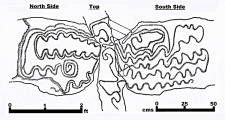
The stone has amazing carvings on it. There are other carvings in the burial chamber, but none so spectacular as this one. Maybe you have noticed the grooves cut into the plinth of the doorway on the first photo? I'm not sure what they signify but I do have a feeling that they are not random.

image by Ray The Mapman of The Megalithic Portal

Above you can see a diagram of the carvings on the original standing stone. Beautiful aren't they. They would make amazing designs for felt. I know after having tried that I am not skilled enough to do Celtic knot work yet. Maybe if I practice some more? But there is something so appealing to me about stone art and cave paintings that makes me want to work with that style. Dorie of Fibre Fusing has already made some outstanding felt based on some of the French cave art, i'd just love to make an Eco dyed Welsh equivalent. Mind you she is one very talented lady i have a very long way to go to catch up!


Do you love this chamber? I know I do :)


Bodowyr Burial Chamber


Bodwyr is a neolithic communal burial chamber dating from the region of 4000-2000bc. its small and quite cute. As always with sites like this, I searched the web for folklore and mythology connecting to it. Rhiannon, contributor to The Modern Antiquarian website, tells that this is one of the sites associated as being the final resting place of Branwen.

Branwen is known in both Welsh Mythology as a Goddess and in Literature as daughter of a High King of Britain. The tale of Branwen goes that Mathwlych, King of Ireland consulted Bran (Branwens brother) with ideas of marriage. Branwen married Mathwlych but after 3 years Mathwlych tired of Branwen and sent her to work in the kitchens. Branwen spent the next 3 years rearing and training a stag whom she later charged to swim across the Irish Sea and carry a message to her brother Bran. On receiving the message, Bran sent an army to rescue Branwen and a bloody battle ensued leaving many killed or injured. the tale can be found the medieval Red Book of Hergest and White Book of Rhydderch.

In the distance you can see the Snowdonia Mountain Range that lies across the Menai Straits. The Menai Straits is a SSSI with a wealth of marine life including Puffins, Seals, and even Dolphins.


Caer Leb


Caer Leb is an iron aged hill fort dating back to 200 BC. There is not much to look at here. The site was excavated in 1865 revealing a stone hut dating from 400ad indicating that this site has been occupied over many centuries similar to Din Lligwy. I like the feeling of continuation to these settlements. Established roots meaning that the site was a good one and people found what they needed to live safely and hopefully happily.

The settlement is the shape of a slice of bread and is double walled due to being built on marsh land. We visited in the last week of October. There had been some rainfall that week so we needed walking boots. It was quite boggy in places but definitely worth a visit. The sun was shining brightly and their was a wonderful feeling of peace to site . I felt content ambling around the site skimming through mole hills looking for naturally upturned artifacts (a tip from an archaeologist friend who has found pottery this way).

Caer Leb is very close to Bodowyr Burial Chamber and Bryn Celli Ddu and we managed to fit all three sites and Beaumauris Castle into one morning, although I could have happily spent the entire day at all four sites if time had allowed it.

Bwrdd Arthur (Din Sylwy) Hill Fort

We stumbled across Bwrdd Arthur whilst trying to find another site on the way to Penmon Priory. We hadn't intended to visit this site, but well if you pass it, you may as well stop and visit right? The Hill fort is on top of a very steep hill and feeling invigorated by the glorious weather we decided to completely ignore the gently winding footpath and took the direct approach in a vertical line up the hill. Phew, I certainly felt a sense of achievement when I got to the top!


We had been looking for remains of walls or other signs of a hill fort (as the name may indicate) and did find lots of stones, but nothing that screamed hill fort at us. Later I looked the site up and found that the name (as Arthur would indicate) is said to be Arthur's table and if you look you can see where the table had been and a stone for each seat. I suppose it helps to know what you are looking at when you visit places like this. I will happily return again though to check this out. The views are second to none, and yes, as the pictures show, even four year olds love this kind of outing. Hills, walls to climb on, burial chambers to climb in and picnic's! What could be better? I've begun to notice that four year olds are very much like hobbits. They crave breakfast, second breakfast, elevenses, lunch, afternoon tea, dinner and supper. Although to my knowledge most halflings do not like mushrooms!


The first two pictures show views out to the Irish Sea and the Snowdonia Mountain range. The third shows views across to Red Wharf Bay. The views are so spectacular up here that I could easily spend an entire day in good weather, maybe with a mini easel or a sketch book. It is just so stunning, and again as with so many sites here on Ynys Mon (The Isle of Anglesey/Mother of Wales) the feeling of sanctuary, of bright spirits and peace are mesmerizing.


_________________________________________


Please join in the fun by sharing pictures, poems, stories or any other form of creative media about a place local to you and close to your heart. Add your post to Mr Linky below :)


Tuesday, 21 September 2010

Sharing Treasure # 2 - LLigwy

Welcome to Sharing Treasure # 2. This month I have 3 sites to share with you. Lligwy Cromlech, Din Lligwy and Hen Capel Lligwy. All within close walking distance of each other.

Lligwy Cromlech

Lligwy Cromlech, a neolithic burial chamber. Cromlech is a word used to describe a burial mound or Dolmon from Welsh, from crom, feminine of crwm bent, arched + llech flat stone. In France, the word Cromlech is used to describe a stone circle, so maybe it is not accidental that the symbol for pi resembles some burial chambers.

Lligwy Cromlech has also been known as Coetan Arthur, Din Lligwy Burial Chamber and Arthur's Quoit. The Cromlech is said to be built upon a natural fissure in the limestone, rather than being dug out.


The site has a peaceful feeling to it. So much so that my 4 year old daughter instantly climbed inside it and lay down on the protruding stone whilst exclaiming that it was her new house and that is her sofa! I could have happily spent much longer here, and plan to return again very soon.

I did a little research into Lligwy Cromlech, looking for history and folklore. Rhiannon, contributor to 'The Modern Antiquarian' kindly shares a tale of a wild stormy night where a fisherman stumbles across a fair maiden struggling to reach the safety of the shore. He wades into the water and pulls the maiden to safety. After taking the maiden (at her request) to Arthur's Quoit he discovers that she is a witch that has been cast overboard and disguised herself to increase her chances of rescue. Afraid to be in the presence of a witch in a known haunted site the fisherman finds himself rewarded with a ball. The witch cautions the fisherman to keep the snakeskin ball safe, and secret from all and good fortune will be his. He shall only take out the ball from its hiding place once a year to bathe it in the sea, and then return it to hiding. If this is not done bad luck will follow. Please visit 'The Modern Antiquarian' to read the full story and see other pictures and accounts of visits to Lligwy Burial Chamber.

Din Lligwy

Din Lligwy is a settlement that is thought to have been built by natives to Anglesey during the Roman occupation. Din refers to 'defensive walls. It is thought that the site was a farming community and may even date back to the iron age. In the picture to the bottom right hand corner below, you can see the walls for one of the round rooms at Din LLigwy. It certainly 'fits' that the settlement dates back to the iron age, as it is very close to Parys Mountain which was mined for copper and other ores since the copper age 3500 years ago. Also, round houses were considered a symbol of status. The Celts and farming communities continued to use round houses until around 200 ad when they began adopting the Roman shaped houses.


Din Lligwy is known to have been occupied by the Romans until around 400ad. The round houses are thought to have been living quarters and the oblong rooms were workshops for iron working and animal shelters.

Hen Capel Lligwy

Hen Capel Lligwy is a wonderful example of medieval history.


The things that intrigue me most about church sites is their connection to sites of pagan worship, ley lines and trees. The church, pictured above, is very small but the trees alongside it are very large for their species.


The Hawthorn below is very large. I felt very attracted by her energy and found myself spending most of my time at this site beside this tree.

When I got home, I researched methods of aging trees without harming them. The Woodland Trust have a lovely tree hugging guide to aging trees of different species.


A Hawthorn only needs an elbow hug, whatever that may be, to qualify as ancient. I think this tree is more than an 'elbow hug' and displays some hallmarks of an ancient tree so I have registered it with The Woodland Trust to verify its age.

The Woodland Trust believe that ancient trees are living relics of incredible age that inspire in us feelings of awe and mystery. We reveal what makes a tree truly ancient, unlock a few of the fascinating secrets and stories associated with them and help you discover why they can sustain such a wide variety of wildlife. 'The Ancient Tree Hunt' is a project that invites members of the public to register trees that may be ancient or veteran with the Woodland Trust. Some of these trees may then be be granted a 'protected' status depending upon what its needs are. So, next time you are out walking and see an inspirational tree, why not give it a hug?

____________________________

If you have a treasure on your doorstep that you would like to share, please add your web link to Mr Linky below.

All are welcome :)